


A Milestone of Early American Enterprise
Few coins capture the birth of American private gold coinage like the 1830 Templeton Reid $2.50. Struck in Georgia during the nation’s first gold rush, this quarter eagle stands at the crossroads of frontier ingenuity, constitutional debate, and the urgent need for circulating money.

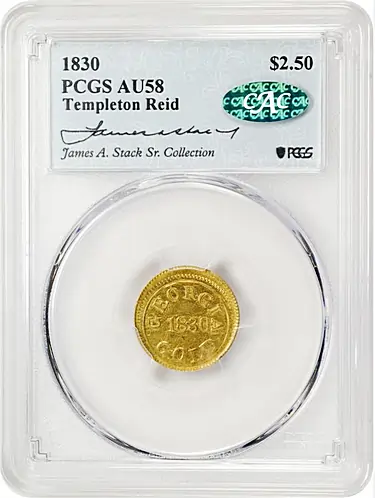
The example offered in the February 2026 Showcase Auction from Stack’s Bowers Galleries brings that story into sharp focus.
Georgia Gold Before the Branch Mints
America’s earliest gold discoveries unfolded in the Carolinas at the turn of the 19th century. Soon after, similar geology revealed rich deposits in northern Georgia. As miners poured into Cherokee lands around 1829–1830, raw gold flooded local markets. Yet turning dust and nuggets into spendable money proved difficult and slow.
That gap invited innovation. Templeton Reid, a skilled mechanic and blacksmith,(in additionto being a jeweler, an expert in watches, a clockmaker and a gunsmith) answered the call in Milledgeville, then Georgia’s capital. In 1830, he began striking gold pieces in denominations of $2.50, $5, and then latter as California Gold $10 & $25.
The whereabouts of only the 1849 $10 Templeton Reid California Gold coins are known
There was one 1849 $25 Templeton Reid California Gold coin that was stolen from the United States Mint Cabinet Collection on August 16, 1858 and has never been recovered. The mystery surrounding this coin, its disappearance, and the existence of possible other coins continues to this day, but with few answers, and many hoping the coin(s) could still eventually turn up.
The gold rush(es) in Georgia and North Carolina eventually led to the establishment of the first United States branch mints in Dahlonega (Georgia) and Charlotte (North Carolina) in 1838.
Regardless, Reid’s goal was simple and practical: transform mined gold into pieces that banks and merchants would accept without hesitation.
The Coin: Boldly Struck and Historically Honest
This 1830 Templeton Reid $2.50, graded AU-58 by PCGS and approved by CAC, shows why collectors prize the issue beyond its rarity. Bright yellow-gold surfaces retain strong luster, while reflective fields highlight the coin’s hand-made origins.

The obverse and reverse alignment tells an important story as well. The off-center relationship suggests a fixed anvil die paired with a handheld hammer die, a clear sign of early private minting methods.
Despite its age and frontier production, the strike displays crisp detail. The rims remain intact, the reeding stays sharp, and the overall eye appeal rises well above expectations for such an early private gold issue. Minor marks appear, yet none distract from the coin’s bold presence or historical integrity.
Why Templeton Reid Matters
Rarity alone never explains the importance of Templeton Reid gold. Fewer than 25 examples of all Reid issues survive today, but significance flows from context, not census numbers. Reid’s coins mark the true beginning of America’s private and territorial gold tradition. Long before federal branch mints opened in Dahlonega and Charlotte, Reid proved that private enterprise could meet a national monetary need.
Contemporary reports confirm that banks accepted Reid’s coins and that the Philadelphia Mint later redeemed them at full value. In fact, many examples likely vanished quickly through re-coining, which explains their extreme scarcity today.
From Circulation to Collectible Legend
By the late 1830s, federal branch mints absorbed the role Reid once filled. His coins disappeared from circulation, but they never faded from memory. By the late 19th century, collectors already recognized Reid’s quarter eagle as a landmark rarity. Early auction records describe it as the first private gold coin of an American gold rush, a distinction that still defines the type.
This specific coin traces an exceptional pedigree through famous collections, including those of Arthur C. Nygren, Hillyer Ryder, and James A. Stack, Sr. Each owner valued the piece not only as a rarity, but also as a tangible link to the nation’s earliest gold economy.
A Centerpiece for Advanced Collections
Today, the 1830 Templeton Reid $2.50 ranks among the most important American gold coins of any era. It speaks to ambition, necessity, and innovation at a moment when the country expanded rapidly and improvised boldly.
For collectors who seek coins with true historical gravity, few issues deliver as completely. This Coin stands ready to command attention once again. It does so not merely as a rare gold coin, but as a defining artifact of America’s first gold rush and the birth of private gold coinage.
The post 1830 Templeton Reid $2.50: The First Gold Coin of an American Gold Rush appeared first on CoinWeek: Rare Coin, Currency, and Bullion News for Collectors.