


The Bolivia 1942 50 Centavos struck on a U.S. wartime nickel planchet ranks among the most unusual discovery coins in modern numismatics. The Philadelphia Mint struck Bolivia’s 1942 coinage under the broader authority Congress gave the Mint to produce coins for foreign nations, and specialists now describe this piece as the only known Bolivia 1942 50 Centavos struck on a U.S. wartime nickel planchet. Mint Error News first published the discovery in 2009, and CoinWeek later revisited the story because of its importance to world mint-error collectors.

A Discovery Coin That Slipped Through Twice
This coin did not reveal its story at once. First, Heritage Auctions offered it in the Whittier Collection of Latin American Coinage on June 2, 2006, as part of Lot 16308, a three-coin group that included a bronze original strike, a supposed silver original strike, and a restrike. Heritage described the “silver” coin as the only reported example. Then NGC added a second layer of confusion when it labeled the piece as a 1942 Bolivia 50 Centavos struck on a 20 Centavos planchet.
Dr. Timothy D. Ziebarth Followed the Evidence
Dr. Timothy D. Ziebarth, Ph.D., did not accept that first attribution. Instead, he studied the coin for roughly a year. He reviewed Foreigner’s in the Mint, a 69-page Mint Error News report on foreign coins struck by the U.S. Mint. He also brought the coin to shows and asked dealers for their opinions. At the 2007 Central States show in St. Louis, he showed the piece to multiple error specialists, including Fred Weinberg. He also consulted David Lange, then NGC’s research director, who agreed that the planchet looked wrong for a copper-nickel piece and urged Ziebarth to send the coin back for a fresh look.
The Planchet Clues Pointed to a War Nickel
That second look changed everything. Ziebarth realized that he had focused on foreign planchets that might have circulated through the Philadelphia facility in 1942, but he had not yet considered U.S. planchets that sat on the same production floor.
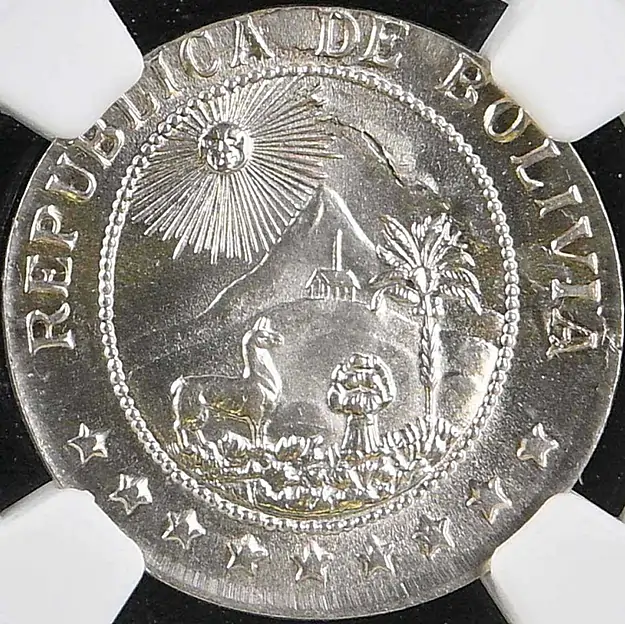
That insight led him to the wartime Jefferson nickel. From 1942 to 1945, the U.S. Mint struck those five-cent coins on a 5.0-gram planchet with an alloy of 56% copper, 35% silver, and 9% manganese. By contrast, current standard references list the regular 1942 Bolivia 50 Centavos as a bronze piece of about 5.1 grams and roughly 24.5 to 24.6 millimeters, while Ziebarth’s original account cited a specification of 5.5 grams and 24.3 millimeters. In other words, the mystery coin fit the smaller U.S. wartime nickel format far better than it fit a normal Bolivian 50 Centavos issue.
NGC Rechecked the Coin and Confirmed the Discovery
Ziebarth then worked directly with Ken Krah, who served as NGC vice president at the time. NGC accepted the coin for a new review and ordered a non-destructive semi-quantitative X-ray analysis from Ledoux & Company in Teaneck, New Jersey. The lab reported 57.5% copper, 36.3% silver, 5.7% rhodium, and 0.4% iron. Ziebarth, who had managed an independent testing lab earlier in his career, explained why those minor-element readings did not derail the case. He noted that semi-quantitative X-ray work can misassign minor elements, especially when overlapping emissions enter the picture. The key result still stood out clearly: the alloy showed copper and silver in proportions that aligned closely with a U.S. wartime nickel, not with a copper-nickel foreign planchet. NGC agreed and reholdered the coin as “1942 BOLIVIA 50C ON US 5C BLANK 4.9G / MINT ERROR MS 65 / WHITTIER COLLECTION.”
Why This Bolivia Mint Error Matters
This Bolivia 1942 50 Centavos matters because it sits at the intersection of U.S. and world numismatics. It also joins one of the hobby’s most coveted categories: wartime wrong-metal errors. In older numismatic shorthand, writers often placed 1943 bronze Lincoln cents around $300,000 and 1944 steel cents in the $50,000 to $100,000 range. Current auction records vary by grade and mint, yet the broader point still holds. Collectors chase these pieces aggressively because World War II created unusual metal substitutions, unusual production pressures, and unusual opportunities for wrong-planchet accidents. That same wartime environment also produced other famous crossover errors, including a 1943 Lincoln cent struck on a Curaçao 25 Cent planchet that Heritage sold for $31,200 in 2021.
A Unique Coin with a Stronger Attribution
Only a handful of world coins struck on U.S. planchets from the wartime years have come to light, and this Bolivia piece stands apart even within that small group. Mint Error News and CoinWeek both present it as unique, and the research trail explains why that claim carries weight. Heritage first grouped it incorrectly. NGC first labeled it incorrectly. Then one determined collector checked the records, studied the planchet standards, consulted experts, and pushed for scientific analysis until the evidence lined up. That process turned an overlooked oddity into one of the most compelling wartime mint errors tied to the Philadelphia Mint.
The Original Source Behind the Discovery
The original discovery story appeared in Mint Error News Issue 27 under the title “Story of the Bolivia 1942 50 Centavos Struck at the Philadelphia Mint on US Wartime Nickel Planchet” by Timothy D. Ziebarth, Ph.D., ANA #3130037. That article remains essential reading because it preserves the full attribution trail from misidentification to final confirmation.
The post Unique Bolivia 1942 50 Centavos Struck on a U.S. Wartime Nickel Planchet appeared first on CoinWeek: Rare Coin, Currency, and Bullion News for Collectors.