


“Such was the unhappy condition of the Roman emperors, that, whatever might be their conduct, their fate was commonly the same…” — Edward Gibbon
The Crisis of the Third Century
The Crisis of the Third Century (c. 235–284 CE) brought chaos to the Roman Empire. Emperors rose quickly. However, most died violently. Often, their own soldiers or courtiers killed them.
At the same time, instability weakened the economy. Inflation surged. The coinage system suffered.
Emperor Aurelian nearly restored order. He strengthened the empire. He also reformed the currency. As a result, he earned the title Restitutor Orbis (“Restorer of the World”). However, conspirators assassinated him in November 275 CE.
Next, the Senate appointed Marcus Claudius Tacitus. Yet his reign lasted only six months. Sources disagree on his death—fever or murder. His half-brother Florianus followed. However, his own troops killed him after just 88 days [1].
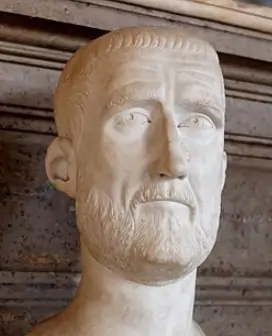
Finally, the army elevated Marcus Aurelius Probus. The Senate approved.
The Rise of Probus
Probus took power at age 44. He already had military success. Therefore, the army supported him strongly.
Despite this, he reportedly accepted the throne reluctantly. Still, he ruled effectively for six years.
However, his reign ended violently. Disgruntled soldiers killed him. They rebelled against orders to drain marshes near Sirmium (modern Serbia).
The Scope of Probus’ Coinage
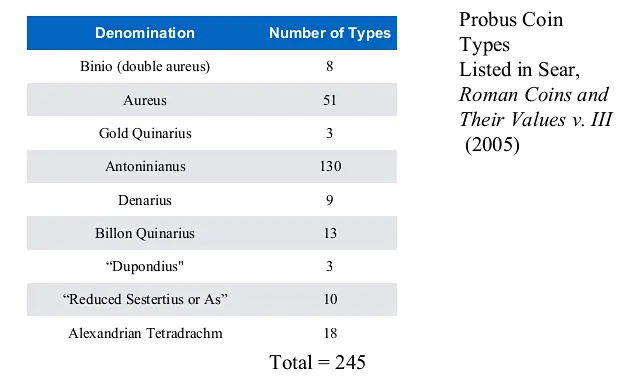
Although Probus ruled briefly, his coinage remains vast. In fact, Sear (2005) lists 245 types. Meanwhile, CoinArchives recorded over 19,000 auction results as of March 26, 2026.
Collectors benefit from this variety. Many common coins remain affordable. Even high-grade examples often sell for under $50.
Major mints include:
- Ticinum
- Lugdunum
- Rome
- Antioch
- Serdica
- Sirmium
- Siscia
- Cyzicus
- Tripolis
In addition, Alexandria struck coins under a separate Egyptian system.
Gold Coinage: Aurei and Biniones
The Roman Empire operated on a gold standard. The aureus contained nearly pure gold. Initially, it weighed about 8 grams. However, emperors gradually reduced the weight:
- Nero: ~7.3 grams
- Caracalla: ~6.5 grams
- Third century: often under 3.5 grams
Even so, gold purity remained high. Therefore, coins often traded by weight.
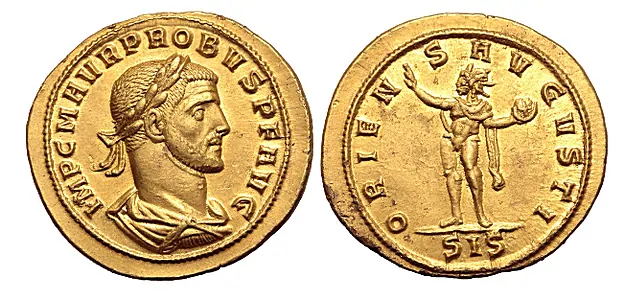
To pay troops, the empire introduced the double aureus (binio). These coins remain rare today.
For example, a Siscia mint specimen sold for over $26,000 in 2022 [2].
Portraiture and Imperial Power
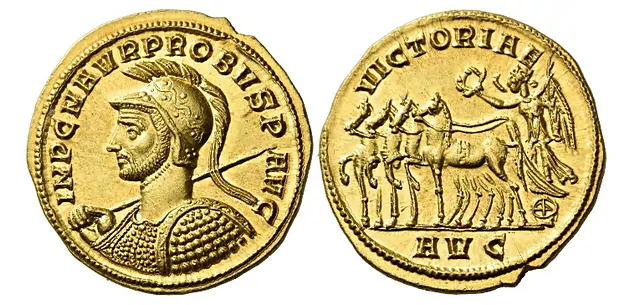
Probus often appears in military attire. He wears armor and a helmet. He also carries a spear and shield.
A Serdica mint aureus shows exceptional artistry. Auctioneers praised its high relief and fine style. Consequently, it realized over $78,000 in 2024 [3].
The Rare Gold Quinarius
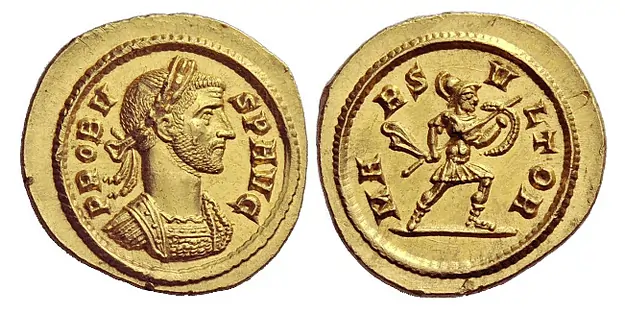
The gold quinarius [4] was valued at one-half an aureus. However, very few survive.
One example from Rome (281 CE) depicts Mars with the inscription MARS VLTOR. Experts called it among the finest known. It sold for over $93,000 in 2011 [5].
The Debased Antoninianus
Originally introduced by Caracalla in 215 CE [6], the antoninianus began as a silver coin. However, inflation reduced its silver content drastically.
Eventually, it became bronze with a thin silver wash.
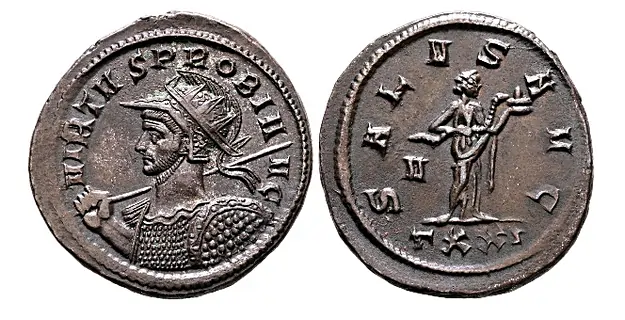
Aurelian attempted reform. He standardized silver content at 5%. Coins bore the mark XXI, meaning 1 part silver in 20 parts alloy.
A Ticinum example shows Salus feeding a sacred snake [7].
Sol Invictus and Imperial Ideology
The cult of Sol Invictus grew during this period. Soldiers especially favored the sun god.
In 273 CE, Aurelian built a grand temple in Rome.
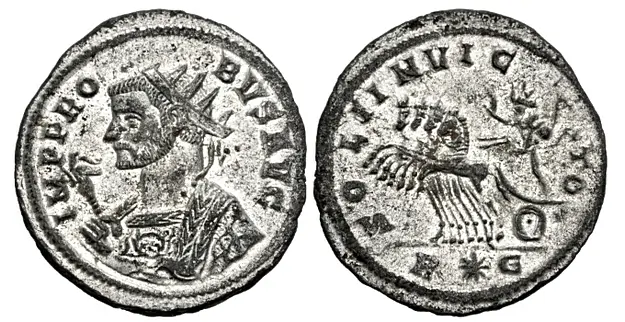
A Probus coin from 278 CE shows Sol driving a chariot. He wears a radiate crown [8]. Notably, this crown became a denomination marker.
The Decline of the Denarius
By Probus’ reign, the denarius had lost value. It became a billon coin with minimal silver.
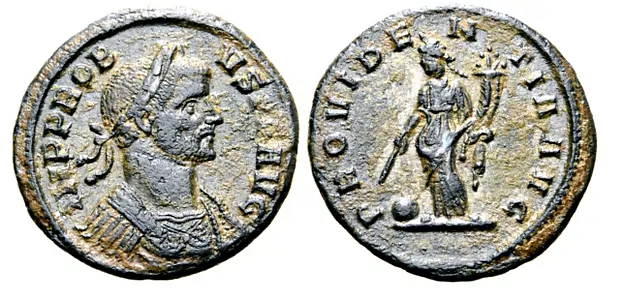
A Rome mint example features Providentia, symbolizing foresight. The type appears rarely today [9].
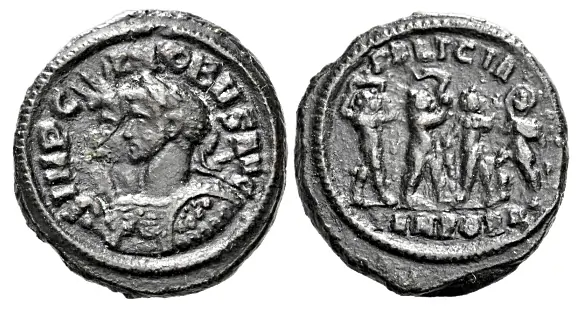
A Tiny but Rare Coin
The billon quinarius equals half a denarius. However, it remains extremely rare.
One example shows Probus with Sol. The reverse depicts four children representing the seasons. The inscription reads FELICIA TEMPORA.
This small coin (1.66g) sold for $4,779 in 2025 [10].
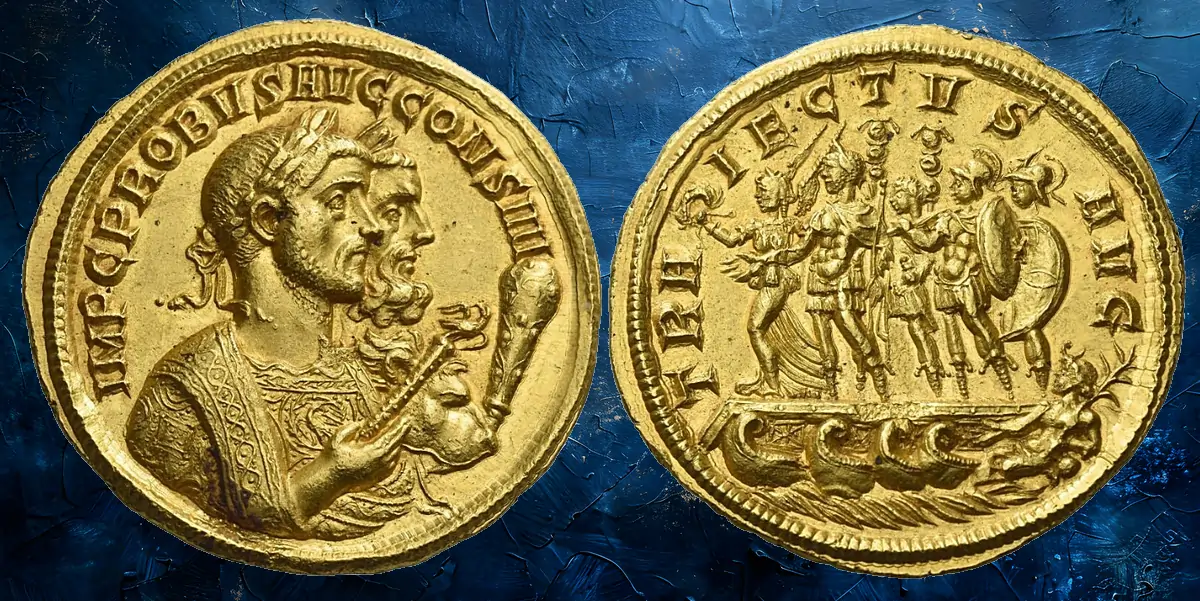
The Ultimate Probus Rarity
Roman medallions served ceremonial purposes. They did not circulate.
A unique gold medallion of Probus weighs 26.05 grams. It dates to 281 CE.
The obverse shows Probus with Hercules. The reverse depicts a Rhine crossing scene with Mars and Victory.
This extraordinary piece sold for over $2.6 million in 2023 [11].
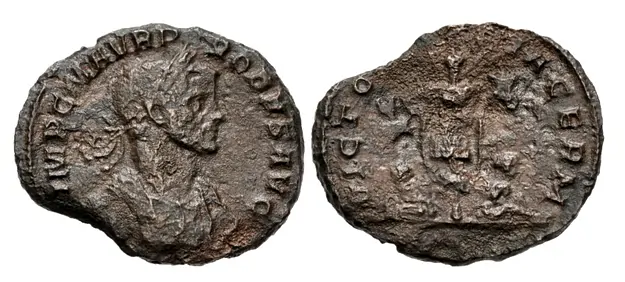
Small Change in Short Supply
Rome struggled to produce low-value coins. The state earned no profit from them.
Collectors label these coins as “Reduced sestertius or As.” They likely equaled one-quarter denarius.
Even worn examples command attention. One sold for $425 in 2023 [12].
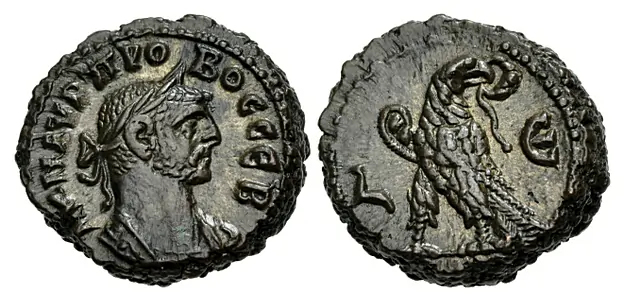
Egypt’s Closed Currency System
Egypt operated separately. Visitors exchanged Roman coins for local tetradrachms.
These coins featured Greek inscriptions. They also used regnal dating.
Although crudely struck, they remain widely available and affordable [13].
Collecting the Coinage of Probus
Collectors enjoy strong availability across all price levels.
Videos Courtesy of Classical Numismatics
Key references include:
- Roman Imperial Coinage (RIC V.II)
- Online Coins of the Roman Empire (OCRE)
Moreover, major auctions regularly feature Probus coins in gold, silver, and bronze.
Videos Courtesy of Classical Numismatics
Conclusion
The coinage of Probus reflects a turbulent era. Yet it also shows resilience. Despite economic strain, the empire produced diverse and innovative coinage.
For collectors, Probus offers both affordability and rarity. Therefore, his coinage remains a compelling field within Roman numismatics.
Videos Courtesy of Classical Numismatics
Citations
[2] Roma Numismatics Auction XXIII, March 24, 2022, Lot 1068, realized $36,368
[3] NAC Auction 150, December 2, 2024, Lot 904, realized $78,847
[4] https://coinweek.com/the-quinarius-an-ancient-roman-coin-youve-never-heard-of/
[5] Nomos Auction 5, October 25, 2011, Lot 253, realized $93,087
[6] “Caracalla” nickname; official name Marcus Aurelius Antoninus
[7] Leu Web Auction 38, December 13, 2025, Lot 249, realized $378
[8] CNG E-auction 606, March 18, 2026, Lot 767, realized $150
[9] Roma Auction XXII, October 7, 2021, Lot 854, realized $490
[10] NAC Auction 153, May 18, 2025, Lot 754, realized $4,779
[11] NAC Auction 138, May 18, 2023, Lot 802, realized $2,651,055
[12] CNG E-auction 536, April 12, 2023, Lot 637, realized $425
[13] CNG E-auction 589, June 18, 2025, Lot 487, realized $80
References:
- Adkins, Lesley and Roy Adkins. Dictionary of Roman Religion. New York (1996)
- Gibbon, Edward. The History of the Decline and Fall of the Roman Empire. 6 volumes. London (1788) online at: https://standardebooks.org/ebooks/edward- gibbon/the-history-of-the-decline-and-fall-of-the-roman-empire
- Kaczanowicz, Wieslaw. Probus the Emperor 276-282 AD: A Biographical Study. Cieszyn, Poland (2003)
- Mattingly, Harold. The Roman Imperial Coinage, Volume V.II: Probus to Amandus. London (1972)
- Scarre, Chris. Chronicle of the Roman Emperors. London (1995)
- Sear, David. Roman Coins and Their Values, Volume III. London (2005)
- Vagi, David. Coinage and History of the Roman Empire. Sidney, OH (1999)
The post The Coinage of Probus (276–282 CE) appeared first on CoinWeek: Rare Coin, Currency, and Bullion News for Collectors.