


By CoinWeek Notes
The 1793 Chain Cent stands at the start of federal coinage. The United States Mint delivered the first 11,178 copper cents on March 1, 1793, from the first Philadelphia Mint. Over the next 12 days, the Mint produced 36,103 Chain Cents. For all practical purposes, these coins mark the first regular-issue United States coins that the federal government struck on its own machinery inside its own Mint building.
Henry Voigt, the Mint’s first Chief Coiner, cut the dies. He kept the design simple, because the young Mint still lacked mature engraving capacity. Even so, Voigt gave the coin a powerful visual identity. He also drew on Augustin Dupré’s Libertas Americana medal for Liberty’s portrait, which linked the new cent to the visual language of the American Revolution.
The Design That Launched the Cent
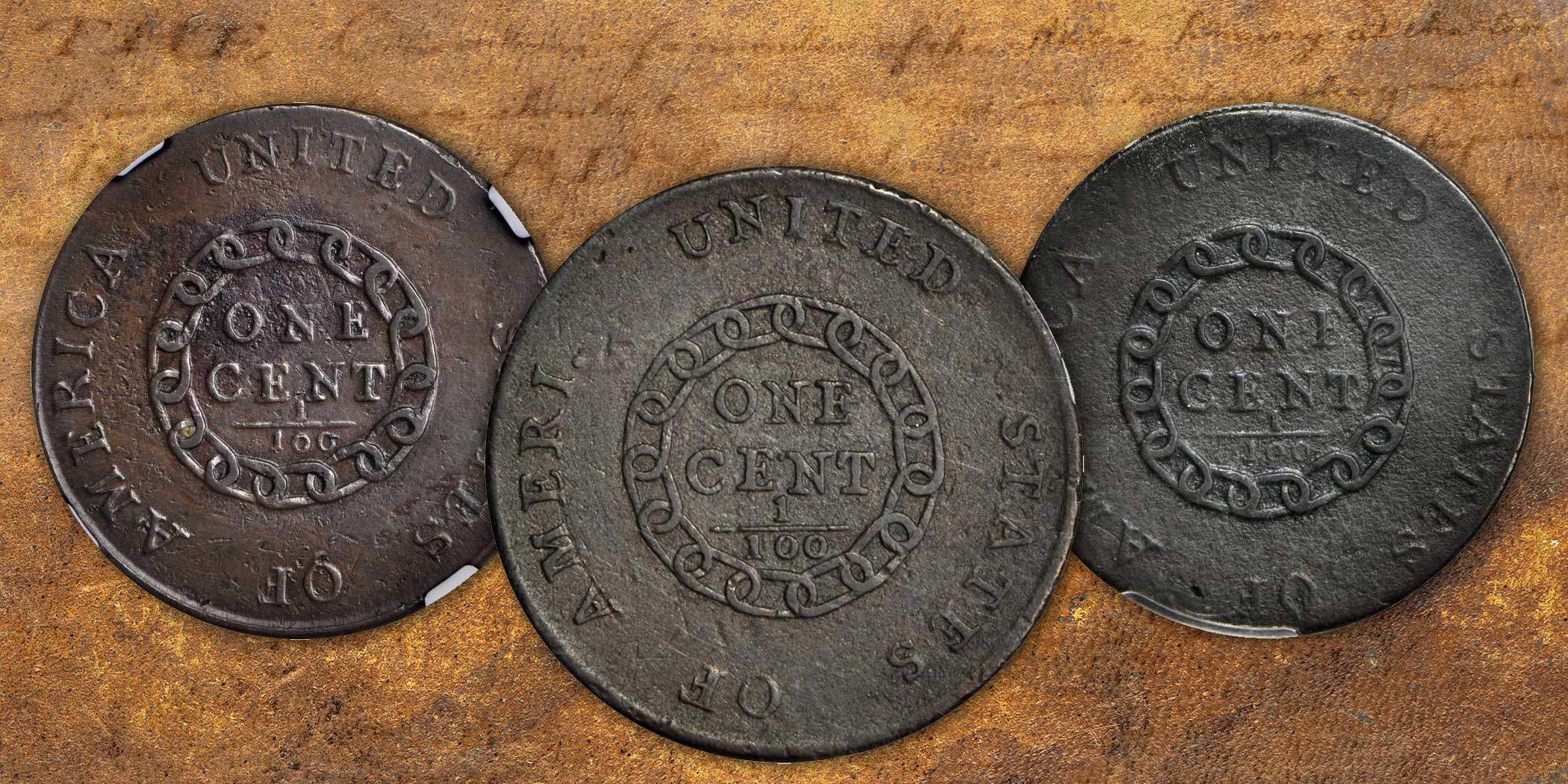
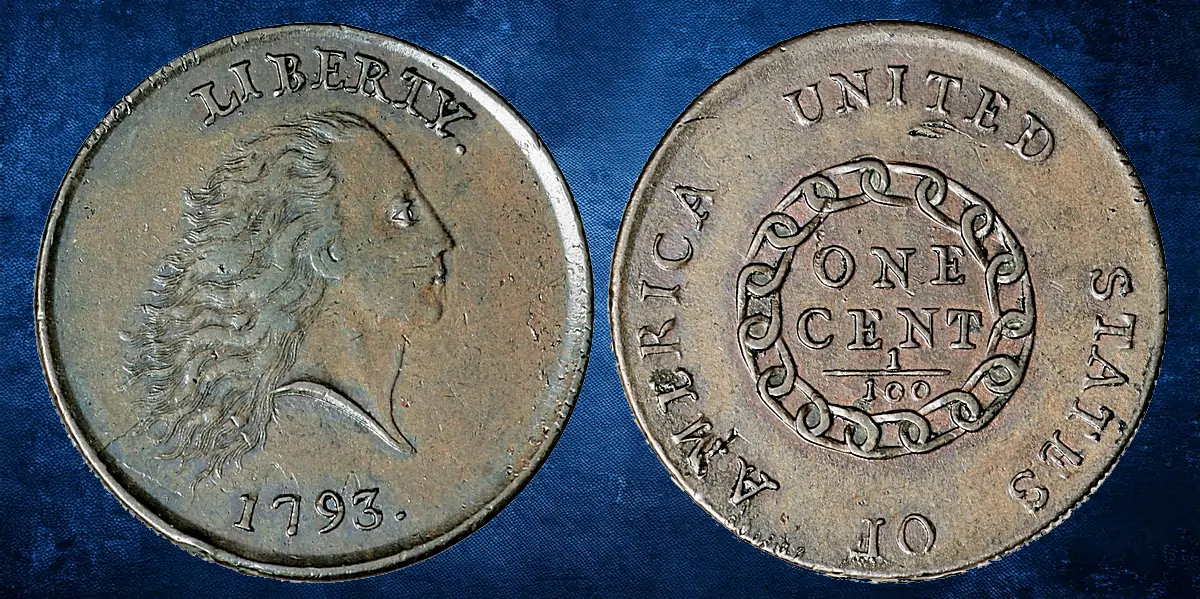
The obverse shows Liberty with flowing hair. LIBERTY appears above her, and the date 1793 sits below the bust truncation. The reverse centers the denomination ONE CENT inside a chain of 15 interlocking links, one for each state in the Union in 1793. Around that motif runs the national legend, clockwise from the top. On Sheldon-1, the engraver abbreviated it as UNITED STATES OF AMERI. On Sheldon-2 through Sheldon-4, the engraver spelled out AMERICA in full.
Yet the public reacted harshly. Newspaper writers did not see a symbol of unity. Instead, they saw a “bad omen for liberty.” One Newark report said Liberty looked “in a fright,” and The Mail in Philadelphia echoed the same complaint on March 18, 1793. The Mint responded quickly. It dropped the chain, introduced the Wreath cent, and moved to a higher-relief replacement.
Eight Deliveries in Twelve Days
The Chain Cent’s production run lasted only 12 days, but it still produced a remarkable amount of history. Contemporary summaries point to eight deliveries: March 1, 11,178; March 2, 2,009; March 4, 4,000; March 5, 3,765; March 6, 1,573; March 8, 7,000; March 9, 1,000; and March 12, 5,578. Those deliveries total 36,103 coins. The Mint struck the Chain Cent in low relief. Soon after, the Wreath cent followed with stronger, higher-relief detail.
The Mint used five die marriages during that brief production window. Four survive as collectible major varieties: Sheldon-1, Sheldon-2, Sheldon-3, and Sheldon-4. A fifth pairing, NC-1, survives in only two known examples and sits outside normal collecting channels.
Sheldon-1: The AMERI. Variety
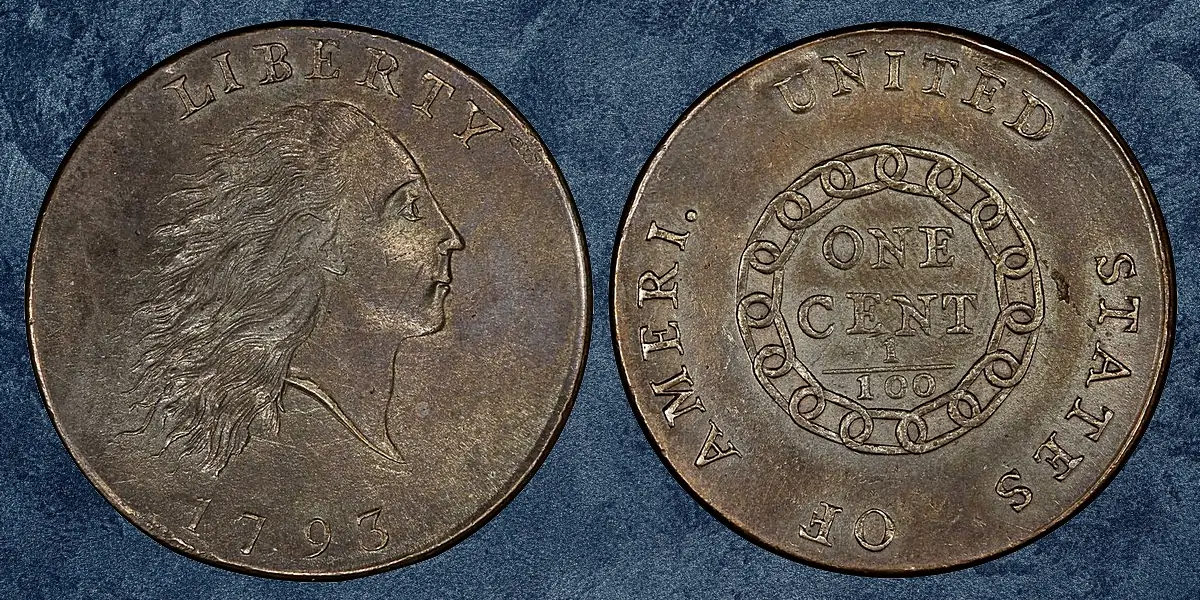
Sheldon-1 carries the famous AMERI. reverse. It shows a wide date, evenly placed LIBERTY, and a lowest hair lock that points toward the 1 in the date. That obverse also served Sheldon-2, but the reverse did not. Sheldon-1 alone uses the abbreviated AMERI. die. Specialists believe that about 7,000 of the March 1 coins came from this marriage, while the rest of that first delivery likely came from Sheldon-2. In Die State Noyes A/B, collectors look for a light crack at the first T in STATES, a bulge above the U in UNITED, and another bulge through the 1 in the date. PCGS estimates 118 to 158 survivors. Later die states show swelling under the U on the reverse and a cud above TAT in STATES.
The market confirms that importance. Heritage sold the Elder-Naftzger-Weinberg Sheldon-1, graded PCGS MS64+BN with CAC, for $1.5 million on January 10, 2019. PCGS also tied that coin to one of the strongest surviving pedigrees in the AMERI. line.
Sheldon-2: AMERICA in Full, Wide Date
Sheldon-2 shifts to the spelled-out AMERICA reverse. It also shows a very wide date, with a noticeable gap between the 17 and the 93, and it presents a better aligned LIBERTY than the other Chain cent varieties. Most importantly, Sheldon-2 introduces the reverse die that the Mint later reused for Sheldon-3, Sheldon-4, and NC-1. Excluding the ultra-rare NC-1, specialists regard Sheldon-2 as the scarcest Chain Cent variety.
Sheldon-3: The Leaning R Variety
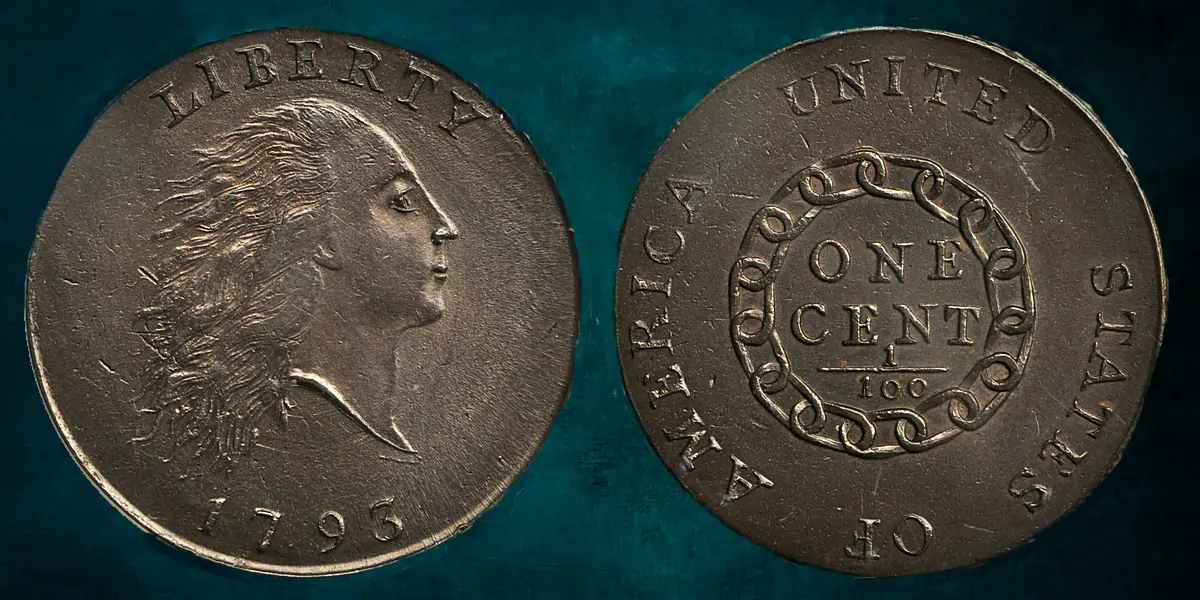
Sheldon-3 gives collectors one of the most distinctive early American cent attributions. The R in LIBERTY leans right, sits slightly larger than the surrounding letters, and creates the famous “Leaning R” look. The date sits close and uneven, with the tops of the 1 and 9 a bit higher than the 7 and 3. The reverse again spells out AMERICA, and the Mint also reused that reverse for Sheldon-2, Sheldon-4, and NC-1. Walter Breen and Mark Borckardt suggested that this marriage may account for as many as 18,000 pieces, which would place much of the March 2 through March 8 output here. Collectors also often find die clash at Liberty’s mouth and neck.
Sharp Sheldon-3 examples rarely survive with full mint life. That scarcity helps explain why the best pieces command elite attention from early copper specialists and advanced type collectors alike.
Stack’s Bowers Catalog Insight: The Garrett-Naftzger-Pogue Sheldon-3
No surviving Chain Cent illustrates the type’s original visual power better than the Garrett-Naftzger-Pogue Sheldon-3. Stack’s Bowers described it as the finest known from those dies and a candidate for the finest Chain Cent of any variety. The catalog emphasized the coin’s mellow light-steel surfaces, which shift toward blue and gold in one light and toward milk-chocolate brown in another. It also noted surviving mint color around LIBERTY and near the rim, plus a reverse bright enough to approach full red under direct light. The coin’s cartwheel luster remains strong on both sides, and the detail still shows the original graver work in Liberty’s hair.
Just as importantly, the catalog used that coin to show the Mint’s early technical growing pains. It pointed to clear die clash from the chain links under the bust truncation and around Liberty’s face. It also noted the raw, hand-finished texture that survives on a coin of this caliber. Those traits matter because they connect the Sheldon-3 directly to the experimental reality of the Mint in early 1793, when press work, planchet feed, and die maintenance still developed in real time.
The provenance adds another layer of importance. The coin surfaced in France with Pierre-Édouard LeGras, then passed through Ed. Frossard and George M. Parsons before it entered the Garrett family holdings. Later owners included Johns Hopkins University, R.E. “Ted” Naftzger, the Foxfire Collection, and D. Brent Pogue. Frossard advertised the coin in 1880 as an original red piece, sharply struck and perfectly uncirculated. More than a century later, Stack’s Bowers sold the Garrett-Naftzger-Pogue Sheldon-3 for $998,750 in February 2016, where it led the Pogue Part III sale.
Sheldon-4: The With-Periods Variety
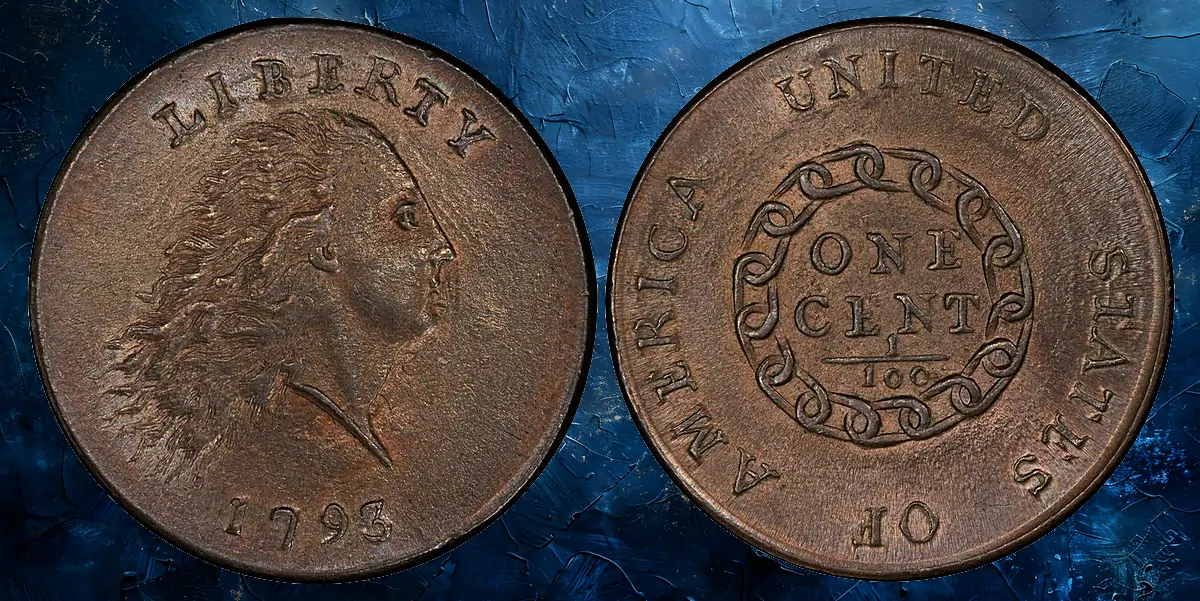
Sheldon-4 closes the Chain cent story. It uses the same AMERICA reverse as Sheldon-2 and Sheldon-3, but it adds a period after LIBERTY and another after the date. No other large cent variety repeats that exact punctuation choice, which gives Sheldon-4 a special place in the series. The variety also shows closely spaced LIBERTY, with the I and E high, and a close date, especially in the final 93. PCGS describes it as the presumed final die marriage of the Chain design. Walter Breen placed its production between March 8 and March 12 and estimated more than 8,000 pieces, while other auction descriptions tie the variety to at least 8,800 coins from those late deliveries.
Collectors continue to chase high-grade Sheldon-4 cents. Heritage sold the Zanoni-Eliasberg MS65BN example for $1.38 million in January 2012, which set a record for any cent at the time. PCGS later noted that the Parmelee-Naftzger MS66BN specimen brought $2.35 million in 2015. Those prices underscore the variety’s deep appeal and its place among the most valuable early American copper coins.
Coin Specifications
The 1793 Chain Cent came from Philadelphia and carries no mintmark. The Mint struck it as a business strike in copper. The standard called for a weight of 13.48 grams, a diameter of about 26 to 27 millimeters, and a bars-and-vines edge. The denomination equals one cent, and the total mintage for the type stands at 36,103 pieces.
Why the 1793 Chain Cent Still Matters
The 1793 Chain Cent still does more than launch a series. It captures the first Mint at work, the first federal cent in commerce, and the first clash between official symbolism and public reaction. It also shows how early American coinage combined idealism, improvisation, and technical struggle in a single copper disc. That mix still drives collector demand today, and it still gives the 1793 Chain Cent a central place in the history of United States numismatics.
The post 1793 Chain Cent: America’s First Federal Cent and the Story Behind Its Varieties appeared first on CoinWeek: Rare Coin, Currency, and Bullion News for Collectors.