


By CoinWeek Notes …..
The Birth of the Two-Cent Piece in 1864
In 1864, Congress passed the Coinage Act of 1864 and introduced a brand-new denomination: the two-cent piece. At the time, lawmakers experimented with several unusual coins, including the Three-Cent Nickel, Silver Trime, Twenty-Cent Piece, and the Stella $4 gold coin.
However, the public never fully embraced the two-cent piece. As a result, the denomination lasted only nine years, from 1864 to 1873. The United States Mint struck the first examples on April 22, 1864.
A Solution to Civil War Coin Shortages
During the American Civil War, Americans hoarded gold and silver coins. Consequently, everyday commerce suffered from a severe shortage of circulating money.
To solve this problem, the federal government increased the production of base-metal coinage. Specifically, officials wanted to replace privately issued tokens and reduce reliance on fractional paper currency. Therefore, the two-cent piece played an important role in stabilizing small transactions during the final years of the war.
The First Appearance of “In God We Trust”
Notably, the 1864 two-cent piece introduced the now-famous motto “In God We Trust” on U.S. coinage. At the time, strong religious sentiment influenced public life across the nation.
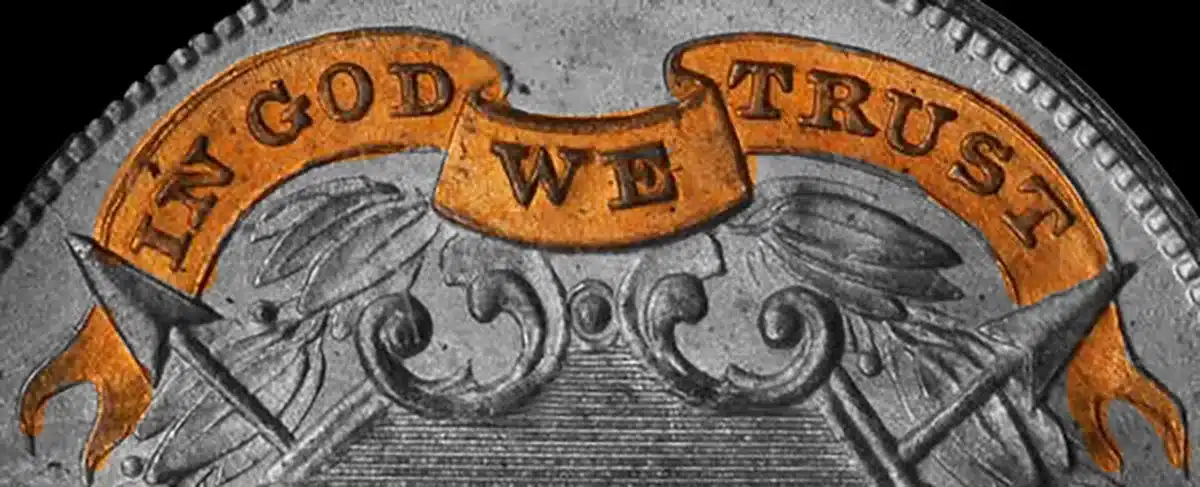
Because of this cultural climate, Mint Director James Pollock received instructions from Congress to add a reference to God on American coins. Meanwhile, Treasury Secretary Salmon P. Chase suggested alternatives such as “Our Country: Our God” and “God, Our Trust.”
Nevertheless, Pollock proposed “In God We Trust,” and officials ultimately approved his version. Earlier, in 1863, the Mint had already tested two pattern coins featuring “God Our Trust” and “In God We Trust.” Many historians believe Pollock drew inspiration from The Star-Spangled Banner.
Mintage Figures and Ongoing Debate
As the first year of issue, 1864 saw the highest production of two-cent pieces. The United States Mint struck all coins at its Philadelphia facility.
However, a later calculation error in 1886 created confusion about the exact mintage. Numismatist R. W. Julian argued that the commonly cited figure of 19,847,500 coins exceeds the true number by 25,000 pieces. Instead, he supported a corrected total of 19,822,500. Today, the A Guide Book of United States Coins follows Julian’s revised estimate.
Small Motto vs. Large Motto Varieties
At the beginning of production, the Mint used prototype dies that featured a smaller and narrower version of the obverse motto. Consequently, these early coins display what collectors now call the “Small Motto” variety.
Numismatist Walter Breen even described these pieces as prototypes. The Mint produced several thousand examples, along with a limited number of Proof coins, using these original dies.
Soon afterward, Chief Engraver James Barton Longacre modified the design. He adjusted the lettering so the motto appeared larger and more upright on the ribbon. This change created the more common “Large Motto” variety known to collectors today.
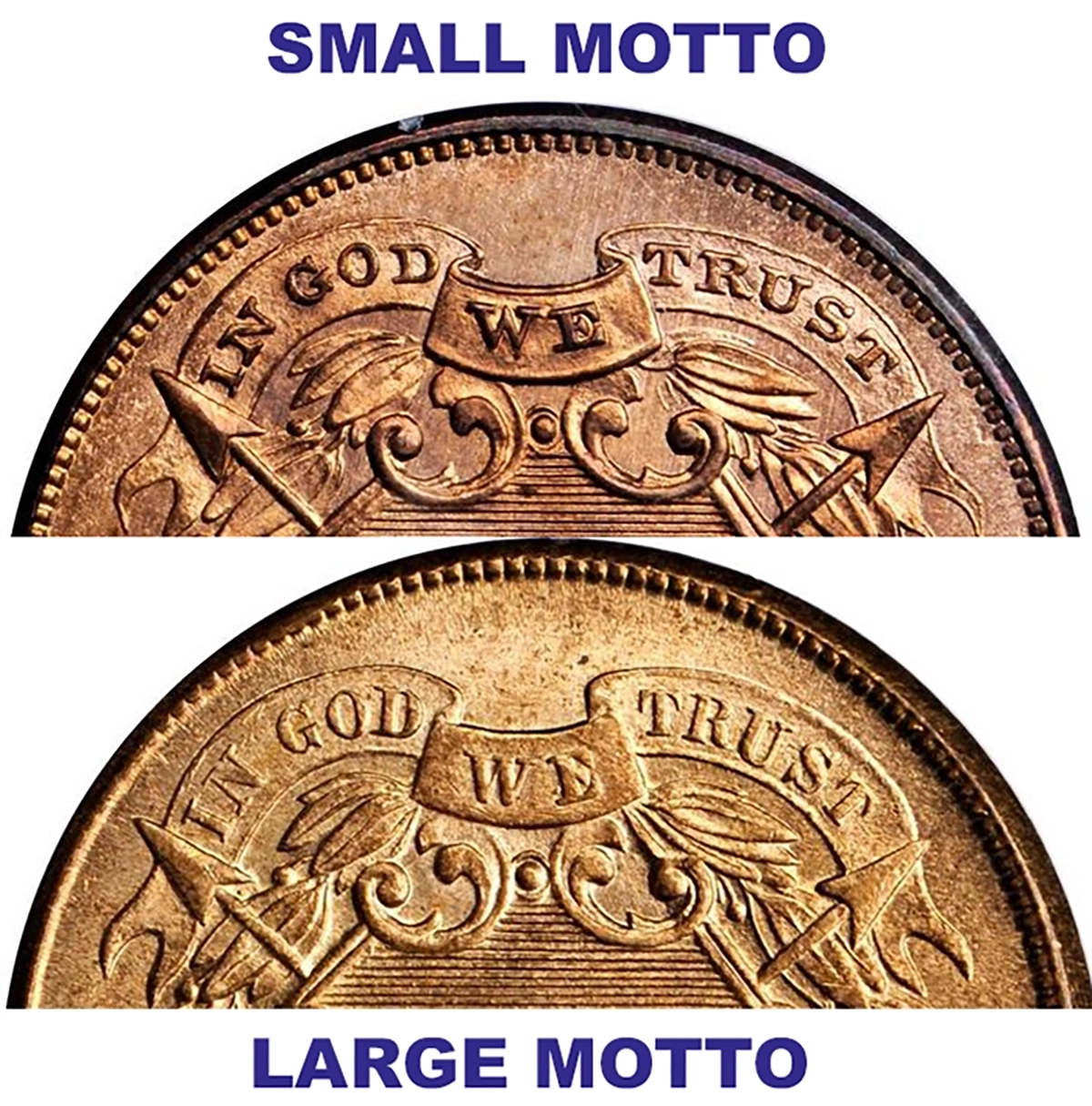
While the motto size difference is not easy to distinguish since it is in a high-wear area, the “D” in “God” is markedly smaller on the Small Motto variety, and the first “T” in “trust” is closer to the ribbon’s fold than on the Large Motto. Additionally, on Small Motto types, the laurel wreath stem under the word “God” is visible, whereas on the Large Motto type, it is hidden.
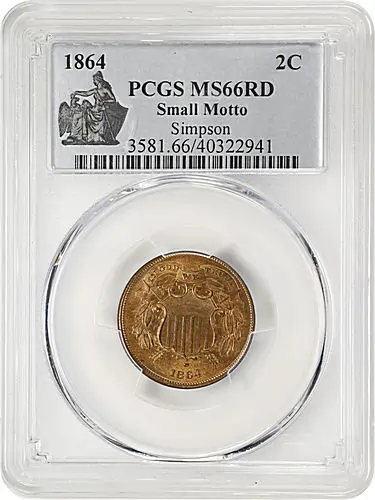
While there is no estimate of how many Small Motto two-cent pieces were struck, PCGS estimates a total survival rate of 10,000, with only 30 in MS 65 or better. As a result, the Small Motto variety is sometimes considered a circulating pattern. In a recurring pattern for the early US Mint, the Philadelphia facility had significant quality control issues. As a result, there are an above-average number of two-cent pieces with die cracks, doubled dies, and repunched dates.
What Is the 1864 Two-Cent Piece Worth Today?
Small Motto examples in low grades (G4–VF30) are easily obtainable for between $200 to $500, and high-grade Mint State Brown examples are rarely found for less than $1,000 to $2,000. Pieces designated Red Brown and Red command a significant premium. An MS66 Red claimed $63,000 in January 2018 at the Heritage FUN sale, the highest auction price of any two-cent piece.
The more common Large Motto variety can be found at any dealer or show for between $20 to $50 in low to medium-low grades. Even in low Mint State (MS60-MS64), Large Motto types with a Brown designation sell for $175 to $400.
Large Motto MS67 Brown types have sold for $7,200 to $7,300; Red pieces of corresponding grade hammered for $19,975 in 2015 and $11,400 in 2020
1864 Two-Cent Piece Design
Obverse Design: A Symbol of Union and Strength
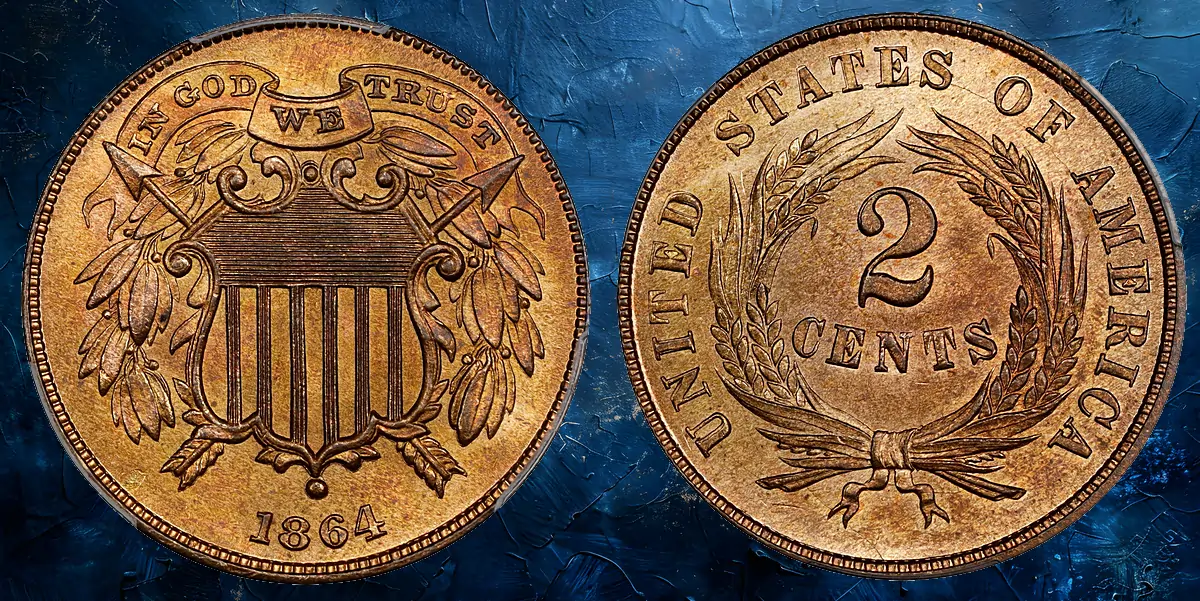
Unlike most American coins, the 1864 Two-Cent Piece does not feature a portrait on the obverse. Instead, Chief Engraver James Barton Longacre created a bold symbolic design based on his interpretation of the Great Seal of the United States.
At the center, a prominent shield dominates the composition. Longacre emphasized defense and unity by including six vertical stripes and twenty horizontal bars. In addition, a pair of crossed arrows appears behind the shield. Although arrows suggest military strength, they also represent alliance and friendship in many Native American traditions.
Moreover, a laurel wreath rises behind the arrows and reinforces the theme of victory. Below the shield, the date “1864” anchors the design in a clean, open field. Above all, a flowing banner stretches across the top and displays the historic motto “IN GOD WE TRUST.”
Taken together, these elements create a powerful visual statement. In fact, the obverse clearly reflects the Federal Government’s determination to preserve the Union during the American Civil War.
Reverse Design: Clear Denomination and Agricultural Motif
On the reverse, Longacre chose a more traditional and balanced layout. At the center, a detailed wheat wreath forms a circular frame. Inside this wreath, the denomination “2 CENTS” appears in two bold lines, which ensures easy readability.

Meanwhile, the legend “UNITED STATES OF AMERICA” curves around the outer edge and fills most of the surrounding space. As a result, the design feels both complete and symmetrical.
Importantly, the coin does not display a mintmark. Because the United States Mint produced all examples in Philadelphia, no additional identifier was necessary.
Edge: Simple and Functional
The edge of the 1864 Two-Cent Piece features a plain, smooth surface. Unlike many other coins of the era, it does not include reeding or edge lettering. This straightforward approach reflects the coin’s practical purpose during a time of economic strain.
Designer: James Barton Longacre
James Barton Longacre ranks among the most influential engravers of the 19th century. Born in 1794, he built a strong reputation as both an artist and a medalist.
In 1844, President John Tyler appointed Longacre as the fourth Chief Engraver of the United States Mint after the death of Christian Gobrecht. Before that appointment, Longacre worked with the Philadelphia firm Murray, Draper, Fairman & Co. However, he later established his own independent engraving business in 1819.
During his independent career, he created detailed portrait engravings of prominent figures such as Andrew Jackson and John C. Calhoun.
After joining the Mint, Longacre designed several iconic American coins. For example, he produced the Flying Eagle cent, the Indian Head cent, the Shield nickel, and the Coronet Head double eagle. Consequently, his work shaped the look of U.S. coinage for decades.
 1864 Two-Cent Piece Specifications
- Country: United States of America
- Year of Issue: 1864
- Denomination: Two Cents (USD)
- Mintmark: None (Philadelphia)
- Mintage: 19,822,500 or 19,847,500 (disputed)
- Alloy: 95% Copper, 5% Tin and Zinc
- Weight: 6.22 grams
- Diameter: 23.00 mm
- Edge: Plain
- Designer: James Barton Longacre
- Strike Type: Business Strike
Why This Design Still Matters
Overall, the 1864 Two-Cent Piece stands out for its symbolic depth and historical context. Not only did it introduce a lasting national motto, but it also captured the spirit of unity during one of the most challenging periods in American history.
The post 1864 Two-Cent Piece : A Collector’s Guide | CoinWeek appeared first on CoinWeek: Rare Coin, Currency, and Bullion News for Collectors.