


By Jesse Kraft for American Numismatic Society (ANS) …..Updated and reformatted by CoinWeek
Goloid Dollars, the “Crime of ’73,” and America’s Silver Crisis
Few moments in American monetary history caused more disruption than the years after California’s gold discoveries. The flood of new gold upset the long-standing ratio between gold and silver. As a result, silver coins traded at $1.04 for every gold dollar. That gap looked small. However, it created a real crisis. Silver coins vanished from circulation because people hoarded them.
Congress stepped in with the Coinage Act of 1853. Lawmakers lowered the weights of the half dime, the dime, the quarter, and the half dollar. That change reduced their intrinsic value and pushed them back into circulation. However, Congress left the silver dollar at full weight. Officials did not want to disrupt its use abroad. At the time, the silver dollar still competed heavily with the Mexican peso in international trade.

Why the Silver Dollar Stayed Out of Circulation
The smaller silver denominations returned to daily use. Even so, Americans continued to hoard silver dollars.
People could still bring uncoined silver or foreign coinage to the United States Mint and turn it into U.S. dollars. Yet the math worked against circulation. A silver dollar contained more than a dollar’s worth of silver. Because of that, owners earned more if they coined their silver into smaller denominations or sold it as bullion to jewelers and other tradespeople.
The Coinage Act of 1873 Changed Everything
Congress tried to solve that problem, along with several others, through the Coinage Act of 1873. That law overhauled a wide range of existing monetary statutes. The silver dollar issue stood near the center of the debate.
Many officials and observers saw the silver dollar as obsolete. They treated it as an accounting novelty with little practical value after the California gold discoveries. After three years of internal deliberation, Congress quietly passed the act. In doing so, lawmakers demonetized silver, among other changes, and pushed the nation onto the gold standard.
However, the high price of silver did not drive that decision by itself. Another fear loomed larger. Officials believed the silver price stood on the edge of a major collapse. Mint Director Henry R. Linderman and Deputy Comptroller of the Currency John Jay Knox knew how much silver the Comstock Lode in Nevada was producing. They understood that this output could send an even stronger shock through the monetary system than the California Gold Rush—or, more precisely, than the government’s response to that gold rush.
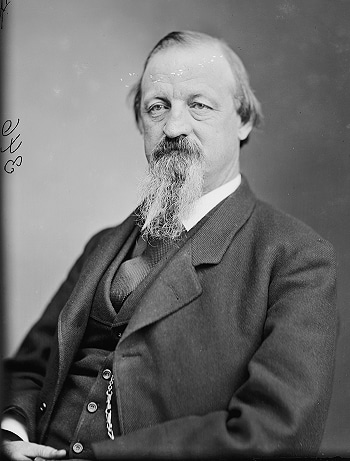
At some point, Linderman and Knox may have recognized another hard truth. In 1853, policymakers likely should have raised the weight of gold coinage instead of lowering the weight of silver coinage. That approach would have produced a more balanced adjustment. However, by 1873, that option no longer appealed to them. The nation already used reduced-weight silver coinage, and silver prices looked ready to fall. Therefore, they chose what they saw as the easier solution: they abandoned silver altogether.
Still, the government needed a large silver coin that could compete with the Mexican peso. So, the Coinage Act of 1873 created the Trade dollar. That coin carried more silver than a traditional silver dollar. However, Congress gave it only limited legal tender status inside the United States. That decision made the coin deeply unpopular at home. In China, it performed only marginally better.
The “Crime of ’73” Took Shape
The silver price did not collapse immediately. In fact, it took until 1876, three years later, for the market to break. At that point, individuals tried to bring their ore to the Mint and have it recoined into silver dollars. Then they learned that the denomination no longer existed.
By 1890, critics had given the Coinage Act of 1873 and the abandonment of bimetallism a memorable name: the “Crime of ’73.” The issue remained a political talking point through the end of the 19th century.
A New Idea Emerged in 1877
From the late 1870s through 1900, politicians, reformers, and monetary thinkers offered many plans to calm the controversy. Congress accepted some of them. It rejected others.
One of the earliest proposals appeared in 1877, just after the public started to grasp the consequences of the Coinage Act of 1873. On April 4, 1876, Dr. William Wheeler Hubbell of Philadelphia applied for a patent titled “Improvement in Metal Alloys for Commercial Coin.” He called his alloy goloid.
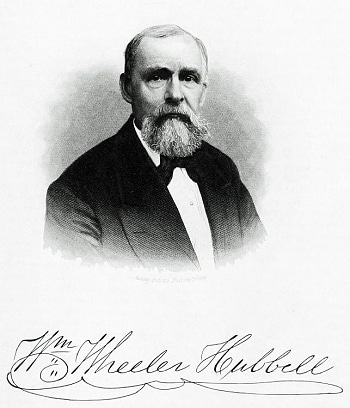
On May 22, 1877, the Patent Office awarded Hubbell patent No. 191,146. Hubbell described goloid in exact terms. He wrote that it “consists of certain proportions of gold, silver, and copper. The exact and best proportions are one pound of gold, twenty-four pounds of silver, and two and a half pounds of copper [and] one grain of sulphate of sodium or sulphate of potassium to one thousand grains of the metal.”
Even then, Hubbell allowed for adjustments. He argued that the silver content could rise to 30 parts instead of 24, or fall as low as 20. He also said the copper could increase to one-eighth of the final weight or drop as low as one-twelfth.
Senator Wallace Took Goloid to Congress
On October 23, 1877, Senator William A. Wallace, Democrat of Pennsylvania, introduced a bill that would have made goloid dollars, half dollars, and quarter dollars legal tender.
The original bill laid out a financing plan as well. It proposed to pay for the coins “by issues of four percent bonds redeemable in ten and payable after twenty years, and to be paid out in exchange for bonds paying a higher rate of interest, as the latter are retired.”
The bill also called for an initial issue of $400 million in goloid coinage.
The Press and Congress Split Over Goloid
The proposal triggered immediate controversy. Congressional debate grew heated. Newspapers weighed in. Meanwhile, Mint officials grew frustrated.
For example, on the day after the proposal appeared, the Eureka Daily Sentinel of Eureka, Nevada, blasted the idea in vivid language: “[W]e send out of the mountains an emphatic protest. Gold or silver straight suits us, but goloid never. Down with the galvanized delusion. There is too much of the pure stuff in the country to admit of this debased nonsense.”
Hubbell’s Case for the Alloy
Hubbell argued that goloid would make counterfeiters’ work much harder. He based that claim largely on the alloy’s density.
As he explained, “Usually, gold and silver alloyed are less in density than the mean of their constituents.” Goloid, however, behaved differently. With its specific formula, it showed an increase in density. The mean density of the individual metals measured 10.685. By contrast, the alloy averaged 10.802.
Hubbell treated that increase as proof that counterfeiters would struggle to copy the coin. However, that argument had limits. A person would need a fairly sophisticated set of tools to determine the density of a goloid coin in the first place.
Hubbell also claimed that the coin would show a golden hue in its outermost layers. He said the natural color of goloid appeared as a purple-golden tone. As the coin wore down in circulation, that color would become even more pronounced. He added one more detail: vinegar or acetic acid would bring out the purple shade at its strongest.
Mint Director Linderman Put Goloid to the Test
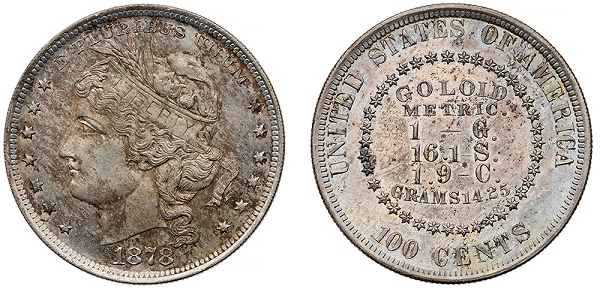
Not everyone shared Hubbell’s optimism. In fact, the Congressional Committee on Coinage, Weights, and Measures asked Mint Director Linderman on December 29, 1877, to prepare sample goloid coins for inspection. Several pieces followed. They featured two different designs, and both designs differed from every other design then in production.
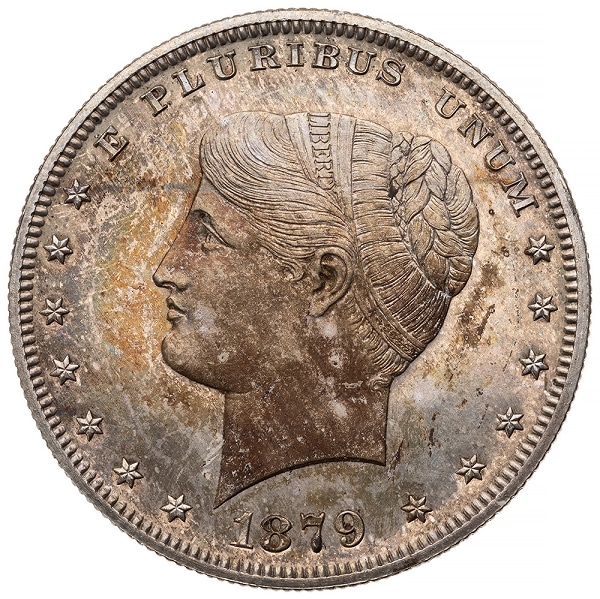
Linderman already knew that goloid and standard silver looked very similar. So he used the inspection as a test for the members of Congress.
He presented two coins. One contained goloid. The other contained 90% fine silver, which matched the composition of circulating silver coinage at the time. He marked the silver coin and explained that “the distinction between them is in the one being blurred in one of the characters, the letter ‘O.’”
Even Linderman struggled to keep the pieces straight. He admitted, “I shall have to look myself to see which one is the goloid dollar.” Then he made the larger point. “It is very difficult for anybody to tell the difference, for the general appearance is the same. The difference between one and the other is not perceptible.”
That visual similarity carried serious consequences. The two coins looked nearly identical. Yet their values differed by about 40 cents. One coin contained about 60 cents in silver. The other contained one dollar in goloid.
Why Goloid Failed
Linderman persuaded Congress. Lawmakers concluded that goloid would create even greater problems for the U.S. monetary system than a falling silver price.
In the end, the alloy doomed itself. It contained too little gold to create a visible difference in appearance. Therefore, Congress rejected the bill.
Soon afterward, Congress chose a different path. On February 28, 1878, lawmakers passed the Bland-Allison Act. That law restored the legal tender status of the silver dollar. It also required the United States Treasury to buy between $2 million and $4 million in silver each month from western mines and coin it.
Goloid Had Ancient Precedents
Goloid did not mark the first time coin makers combined gold and silver into a single composition. Today, numismatists know that alloy as electrum.
In fact, coinage first used that combination as early as the seventh century BCE. The most famous early examples came from Lydia. Those electrum issues spread across western Asia Minor, eastern ancient Greece, and the wider Mediterranean world over the next few centuries.

Later, during the 11th through 14th centuries, a succession of Byzantine emperors issued electrum coinage. Then, in the 19th century, Japanese shogunates struck their own electrum coins.
Many sources still claim that ancient electrum formed naturally as a blend of gold and silver. However, current research points in another direction. Researchers now conclude that people manufactured even the earliest electrum pieces. In that sense, those ancient coins and Hubbell’s goloid shared a common origin as deliberate alloys.
What Goloid Still Teaches Collectors and Historians
Researchers have far more primary source material for United States goloid coinage than for ancient electrum coinage. Even so, the ancient and modern stories speak to each other.
Goloid never entered circulation. It never solved America’s silver problem. Yet the experiment still reveals how lawmakers, Mint officials, and inventors grappled with one of the most unstable monetary moments in U.S. history. It also suggests that modern observers may still learn something from the experiences and observations attached to these unusual pieces.
* * *
The post Goloid Dollars: America’s Electrum Coinage appeared first on CoinWeek: Rare Coin, Currency, and Bullion News for Collectors.