


By CoinWeek
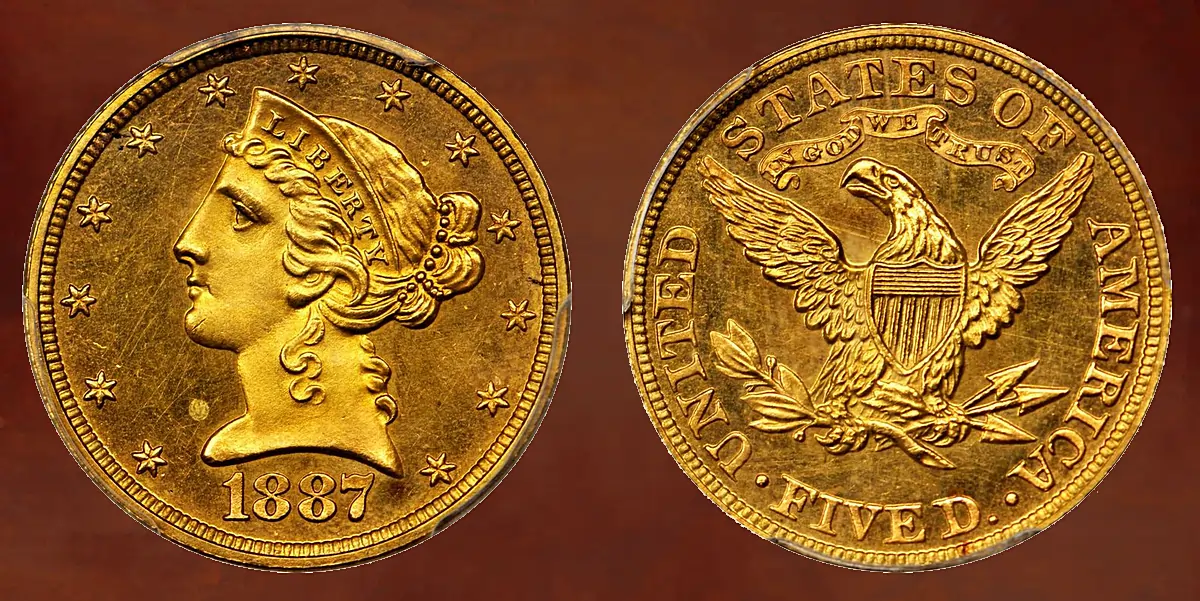
Few U.S. gold coins inspire as much curiosity as the 1887 Liberty Head Half Eagle. At first glance, it appears to be just another late-date $5 gold piece from the With Motto era. However, a deeper look reveals something far more compelling. In fact, the 1887 Half Eagle stands alone in American numismatics as the only Proof-only half eagle of any design type.
That singular distinction raises an obvious question: why?
Despite decades of research, no definitive explanation exists. Nevertheless, when the coin is placed within its broader historical, economic, and numismatic context, the story becomes clearer. Moreover, its rarity, pricing structure, and long-term collecting potential make the 1887 Half Eagle one of the most intriguing Proof gold issues of the 19th century.
A Proof-Only Mystery in a Year of Heavy Gold Coinage
To understand the enigma of the 1887 Half Eagle, it helps to look at what didn’t happen that year. No business strike $5 gold coins were produced at Philadelphia in 1887. Instead, the Mint struck the denomination exclusively in Proof format.
This decision becomes even more puzzling when compared to activity at the San Francisco Mint. That same year, the 1887-S Half Eagle recorded a staggering mintage of 1,912,000 pieces. While lower than the record-setting 1886-S mintage of 3,268,000, it still ranked among the highest outputs of the entire Liberty Head Half Eagle series.
In fact, San Francisco would not exceed the 1887-S figure again until 1901-S, when 3,648,000 half eagles were struck. Clearly, demand for gold coinage existed. So why did Philadelphia abstain from striking circulation pieces?
The most compelling explanation likely lies in the ongoing struggle between gold and silver interests during the late 1880s. This period saw intense political and economic debate over bimetallism, bullion usage, and monetary policy. Significantly, the double eagle ($20 gold) also failed to appear in business strike form in 1887. That parallel strongly suggests a broader policy decision rather than a denomination-specific anomaly.
A Tiny Mintage and Even Smaller Survival Rate
The Philadelphia Mint produced just 87 Proof 1887 Half Eagles, a microscopic figure by any standard. Today, numismatists estimate that only around three dozen examples survive in all grades combined.
Even more surprising, however, is how many of those survivors show impairment. Unlike other Proof gold rarities of the era, the 1887 Half Eagle does not appear to have been widely recognized as a rarity at the time of issue.
As a result, roughly 25% to 33% of known examples are either circulated Proofs or have been noticeably cleaned. This stands in sharp contrast to better-known Proof-only issues such as the 1875 and 1876 Three Dollar Gold pieces, which were actively saved by contemporary collectors.
Consequently, original, problem-free examples of the 1887 Half Eagle are far scarcer than the already-low survival estimates might suggest.
Cameo Contrast: Subtle and Often Overstated
From a technical standpoint, the 1887 Proof Half Eagle presents another nuance that collectors must understand. While many Proof half eagles dated between 1880 and 1886 exhibit strong contrast between frosted devices and mirrored fields, this is generally not the case for 1887.
Most examples display only modest contrast. Furthermore, pieces designated DCAM (Deep Cameo) by PCGS often show little more visual separation than those labeled simply as Cameo.
In practice, this means collectors should rely less on the label and more on their own eyes. Surface quality, originality, and overall eye appeal matter far more for this issue than aggressive cameo designations.

No Clear Finest Known Example
Unlike many Proof gold issues, the 1887 Half Eagle does not have a universally recognized finest known specimen. Condition census rankings vary, and the surviving population is simply too small, and too inconsistent, for a clear hierarchy to emerge.
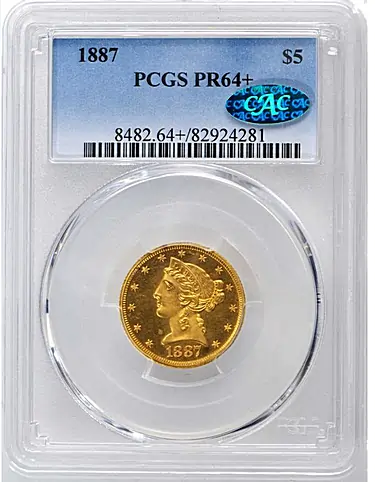
That said, the current auction price record (APR) provides an important benchmark. In 2018, Stack’s Bowers offered a PCGS/CAC PR65CAM example [The W. F. Dunham Specimen] as part of its ANA sale. The coin realized $144,000, establishing the high-water mark for the issue.
Notably, CAC approval played a key role in that result. Given the prevalence of cleaned and impaired pieces, third-party verification of originality carries exceptional weight for this date.
Pricing Multiples: Aggressive but Not Absurd
Price guides typically assign significant premiums to the 1887 Half Eagle relative to more available Proof issues. In many cases, the multiples approach 3x when compared to Proof 1884 or 1886 Half Eagles.
For example:
- PR63 examples are often listed around $60,000, versus roughly $20,000 for comparable dates.
- PR64 pieces frequently appear at $120,000, compared to about $40,000 for their counterparts.
While a 2x multiple feels intuitive based on rarity alone, a 3x multiple can be harder to justify purely on population data. Even so, the Proof-only status of the 1887 Half Eagle fundamentally changes the equation.
Importantly, this is not a case of artificial scarcity or conditional rarity. The coin simply was not struck for circulation, ever. When viewed through that lens, the pricing premium appears far more reasonable.
A Sleeper Coin in an Underrated Set
One of the most compelling aspects of the 1887 Half Eagle lies in its broader collecting context. A complete With Motto Liberty Head Half Eagle set remains challenging but achievable. Unlike many gold series, it does not require multiple unobtainable six-figure coins.
Within such a set, the 1887 serves as a natural centerpiece. It adds a layer of depth, historical intrigue, and technical distinction that few other dates can match.
Moreover, as advanced collectors increasingly gravitate toward short sets, Proof-only issues, and historically significant anomalies, the 1887 Half Eagle stands to benefit. Its story aligns perfectly with modern collecting trends that prioritize narrative as much as numerical rarity.
Final Thoughts: An Enigma Worth Studying, and Owning
The 1887 Liberty Head Half Eagle is far more than just a rare Proof gold coin. It represents a moment when monetary policy, mint operations, and collector behavior intersected in an unusual way.
Its Proof-only status, tiny mintage, modest survival rate, and subtle visual characteristics all contribute to its mystique. At the same time, its pricing, while strong, remains defensible when compared to similarly rare Proof gold issues.
For collectors willing to look beyond conventional checklists, the 1887 Half Eagle offers something increasingly rare in modern numismatics: a coin that still invites questions. And in a hobby driven by discovery, that may be its greatest appeal of all.
* * *
The post The 1887 Half Eagle: America’s Only Proof-Only $5 Gold Coin appeared first on CoinWeek: Rare Coin, Currency, and Bullion News for Collectors.