


In the world of modern U.S. coinage, very few circulation errors have achieved true landmark status. One that consistently stands above the rest is the 1982 No-P Roosevelt dime, a coin struck not in the distant past, but during the early 1980s, when millions of Americans were actively handling change every day.
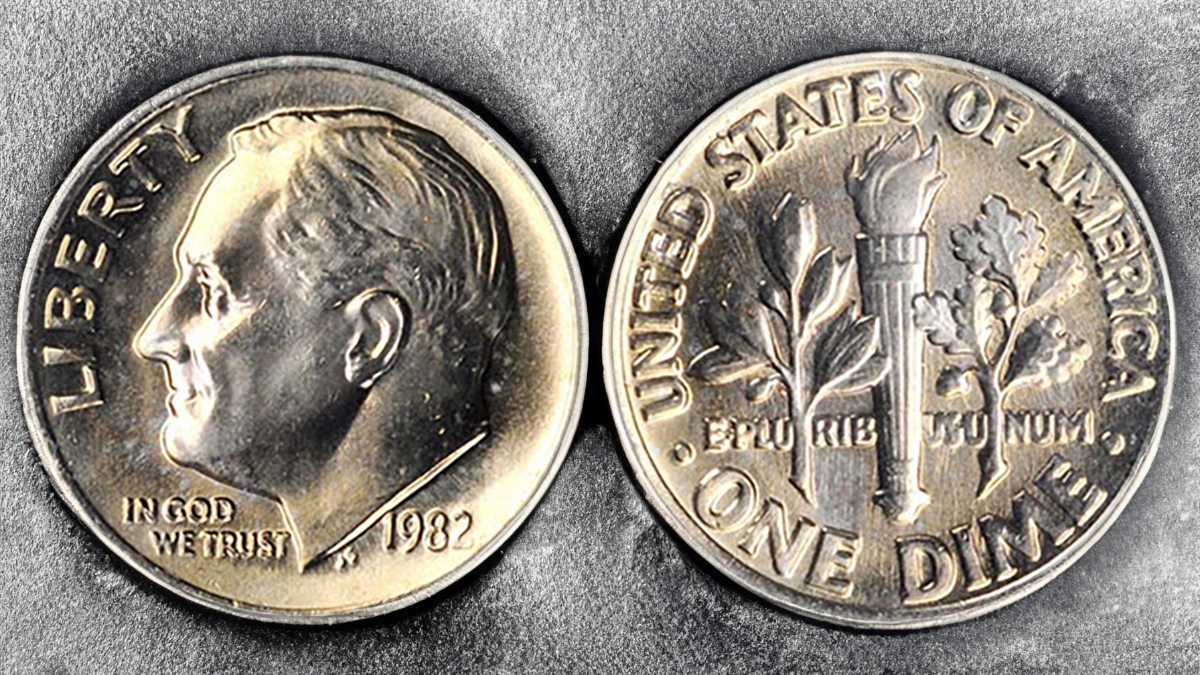
That timing is crucial to its appeal. Unlike classic rarities that disappeared generations ago, the 1982 No-P dime entered everyday commerce. It passed through banks, amusement parks, vending machines, and cash drawers before collectors realized something was wrong. Today, it stands as the most important circulation-strike error in the Roosevelt dime series and one of the most significant modern Mint mistakes of the late 20th century.
Despite its modern origin, the coin possesses every trait collectors prize: a simple and understandable error, a direct link to Mint procedures, a discovery rooted in circulation, a limited but unknowable population, and a value range that continues to surprise even seasoned numismatists.
The Mintmark Change That Set the Stage
To understand why a missing mintmark on a 1982 dime matters, it’s necessary to look at what changed just two years earlier.
For most of U.S. Mint history, Philadelphia coins did not carry a mintmark. With few exceptions, most notably wartime nickels, Philadelphia production was identified by the absence of a letter, while Denver and San Francisco used “D” and “S.”
That changed in 1980, when the Mint began adding a “P” mintmark to all Philadelphia coins except cents. From that point forward, every circulating Philadelphia dime dated 1980 or later was supposed to carry a visible “P” above the date.
That policy shift is what makes the 1982 No-P dime so notable. After 1980, a mintmark-less Philadelphia dime should not exist at all.
How the No-P Error Happened
The 1982 No-P dime resulted from a single breakdown in the die-preparation process.
At the time, mintmarks were still added manually. Each working die received its mintmark punch by hand before the die was hardened and placed into service. In this case, one Philadelphia working die was never punched with the “P” mintmark but was nonetheless approved for use.
As a result, every dime struck from that die emerged without a mintmark. These coins looked perfectly normal to the casual observer, closely resembling pre-1980 Philadelphia dimes, except for the unmistakable 1982 date. Evidence strongly suggests the entire variety was produced from a single die, which explains both its scarcity and its consistency.
Once the die entered production, thousands of error dimes flowed directly into circulation.
Discovery in Sandusky, Ohio
The discovery story is one of the reasons the No-P dime remains so popular.
The first confirmed examples surfaced in late 1982, most notably in Sandusky, Ohio, near the popular amusement park Cedar Point. Employees, local businesses, and collectors noticed unusual 1982 dimes appearing in everyday change. The setting, an amusement park handling massive volumes of coinage, helped the error surface quickly.

As word spread, collectors across the Midwest began searching rolls of dimes, and additional examples were reported in surrounding regions. The geographic clustering supports the idea of a limited release rather than nationwide distribution.
How Rare Is the 1982 No-P Dime?
The U.S. Mint has never published production figures for the error, and because the coins circulated normally, an exact population will never be known.
However, submission data offers important insight. Based on certification totals at PCGS and NGC, the 1982 No-P dime ranks as the most-submitted clad Roosevelt dime variety, with the lone exception of the 1996-W dime. That comparison is telling. Unlike the 1996-W, which was a novelty coin never intended for circulation, the No-P dime is a genuine production error that entered commerce organically.
Collector consensus suggests that while thousands may exist, survival drops sharply in higher grades. This places the coin in a sweet spot: scarce enough to be respected, yet available enough to remain collectible.
Identifying a Genuine No-P Dime
Authenticating the 1982 No-P dime is straightforward when you know what to look for. The date must be 1982, no other year qualifies. A genuine example shows absolutely no trace of a mintmark above the date, with no outline, shadow, tooling marks, or disturbed metal. The coin must also match the normal die characteristics of 1982 Philadelphia dimes, including proper portrait detail and correct spacing.
Altered coins, where the “P” has been scratched away, are common but easy to detect under magnification. Wear alone will not completely remove a mintmark in a natural way.
Strong vs. Weak No-P Dimes
Most numismatic references recognize two strike classes of the 1982 No-P dime: Strong and Weak.
These terms do not describe the mintmark, both lack it entirely, but rather the completeness of the strike. Strong No-P dimes show crisp design details, particularly around the rims and lettering, closely matching a fully struck normal issue. Weak examples exhibit flattened outer details, with portions of the design nearly obliterated.
While both are legitimate varieties, many collectors consider the Strong No-P to be the more desirable and numismatically interesting of the two. Collecting both is a personal choice, but market demand tends to favor sharply struck examples.
Market Values and Collector Demand
Values for the 1982 No-P dime vary widely by condition.
Circulated examples in Extra Fine condition typically trade around $30, making them accessible entry points for collectors. Uncirculated pieces bring substantially more. A Mint State example in Gem condition or better often commands $300 or more, with premiums rising quickly for coins certified in the upper Mint State range.
As with most modern errors, condition rarity is the primary driver of price. High-grade, well-struck examples are significantly scarcer than the raw population numbers suggest.
Why the 1982 No-P Dime Still Matters
More than forty years after its discovery, the 1982 No-P Roosevelt dime remains a cornerstone of modern U.S. numismatics. It demonstrates how a single overlooked step in Mint procedure can create a lasting rarity. It shows that meaningful errors did not end with the silver era. And it continues to fuel the enduring appeal of searching everyday change.
Perhaps most importantly, it proves that modern coins can still tell compelling stories, stories rooted not in vaults or proof sets, but in real circulation.
A Small Coin with Lasting Significance
The 1982 No-P Roosevelt dime doesn’t rely on mystery or speculation. Its error is clear, its history well documented, and its desirability firmly established. Whether found in a coin roll, acquired for a Roosevelt dime set, or pursued as a standalone error, it remains one of the most important modern U.S. coins ever struck.
In a hobby built on history, the No-P dime is a reminder that history sometimes happens quietly, one missing letter at a time.
The post The 1982 No-P Roosevelt Dime: The Most Famous Modern Circulation Error appeared first on CoinWeek: Rare Coin, Currency, and Bullion News for Collectors.